


Do It Yourself Kits
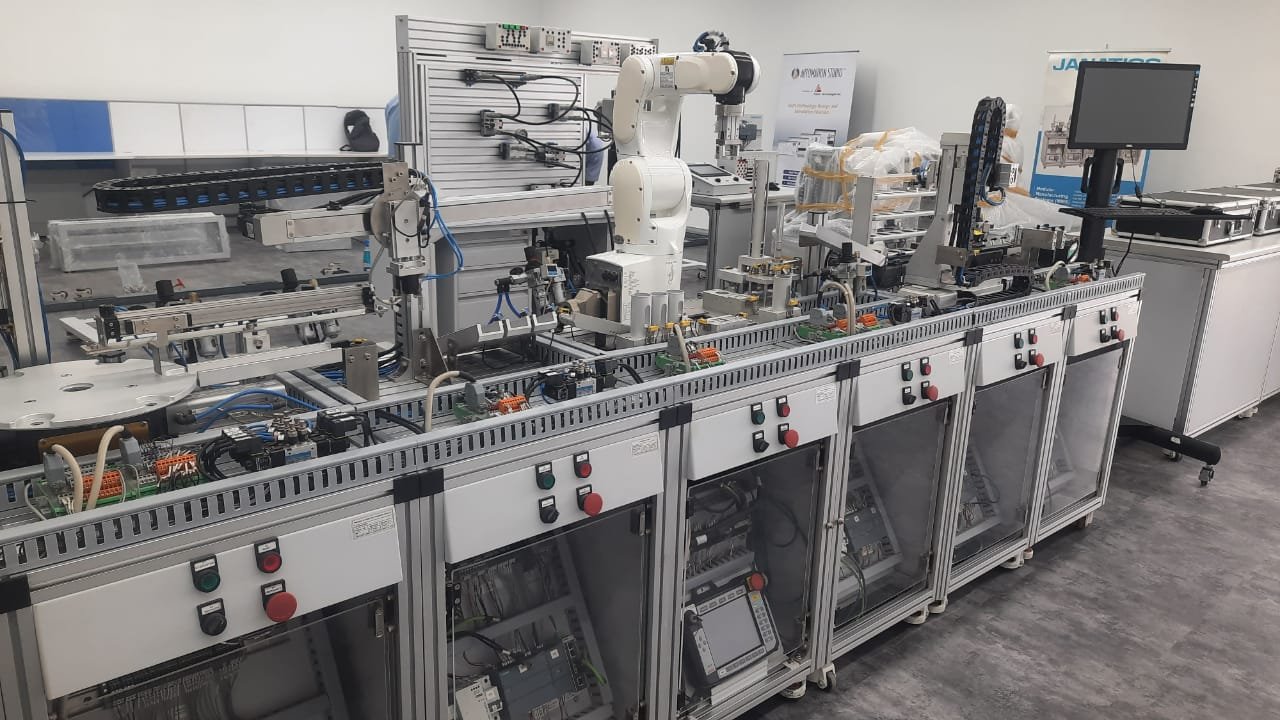
DIY Series: Modular Mechatronics System
Empowering the Architect of Tomorrow’s Automation
The Series DIY kits are sophisticated, modular mechatronics systems designed to empower students and professionals to build fully functional automation setups without requiring external professional assistance. Unlike standard trainers, the DIY series focuses on the complete assembly, integration, and testing of real-world industrial scenarios.
01.
Hands-On Learning
Each kit provides practical exposure to automation, pneumatics, robotics, and control systems, bridging the gap between theory and real-world application.
02.
Versatile Applications
From colour sorting to pick-and-place modules, the kits cover diverse industrial and educational use cases, making them suitable for students, trainers, and industry professionals.
The DIY Concept: Build. Test. Innovate.
Our DIY kits serve as a bridge between theoretical design and actual industrial implementation. By utilizing these modules, users gain deep insights into how various technologies converge to create a seamless automated process.
- Technology Integration: Seamlessly combine Pneumatics, Electrical systems, PLC logic, Mechanical structures, and Sensors.
- Actual Industrial Scenarios: Every kit is engineered to produce applications that replicate real-life industrial functions, such as sorting, feeding, and processing.
- Modular Flexibility: Build and test new automation systems of your own design by reconfiguring the modular components.
Featured Module: DIY Feeder Station (DIY01)
The Feeder Station is a prime example of our modular mechatronics approach. It focuses on the separation and distribution of components for downstream manufacturing.
Key Features
- Comprehensive Learning Material: Includes a detailed workbook with specific tasks and solutions to guide the assembly and programming process.
- Complete Toolset: Each station comes with a full set of tools required for both assembly and dismantling, ensuring a self-contained learning experience.
- Component Storage: Features precut foam inserts for organized parts storage and inventory management.
- Modular Components: Includes a stack magazine for component storage and a rotary pick-and-place module for precision distribution.
Technical Components & Specifications
The DIY series is built on a foundation of industrial-grade hardware to ensure durability and realistic performance.
- Control Infrastructure: PLC control integration (Siemens™ / IEC compatible) with dedicated I/O interface modules and a control console.
- Pneumatic Power: Features a complete FRL (Filter, Regulator, Lubricator) module, valve manifold assemblies, and compact ejector modules.
- Mechanical Foundation: Supported by horizontal profile table workbenches and profile plates specifically designed for mechatronics mounting.
- Safety & Environment: Rated for ambient temperatures up to 60°C and operating pressures of 4 bar.
Educational Objectives
Through the DIY Series, BaaS Systems enables users to master:
- System Assembly: Physical construction of mechatronic stations from the ground up.
- Logic Programming: Developing PLC ladder logic to control complex sequences.
- Sensor Calibration: Integrating and fine-tuning sensors for position and material detection.
- Fault Finding: Developing diagnostic skills within a functional, hybrid system.
- CPU
- MEMORY
- NOTE
Powered by the 8085 microprocessor operating at 3.072 MHz, ensuring stable performance for training and experimentation.
Supports up to 64KB memory (32KB EPROM and 32KB RAM) with a battery backup option for RAM, making it reliable for extended use.
The trainer kit comes preconfigured with 16KB EPROM and 8KB RAM for immediate use and easy upgrades.
- Key Features
- Applications
Processor: TMS320C6748 DSP from Texas Instruments.
Ease of Use: User-friendly design suitable for beginners as well as professionals.
Applications: From simple signal processing and analytics to real-time audio and video processing.
Debugging Support: Integrated with XDS100 V3 JTAG emulator for efficient development and testing.
Engineering and Polytechnic colleges.
Research labs and training centers.
Industrial training programs for skill development.